
SAT Overview
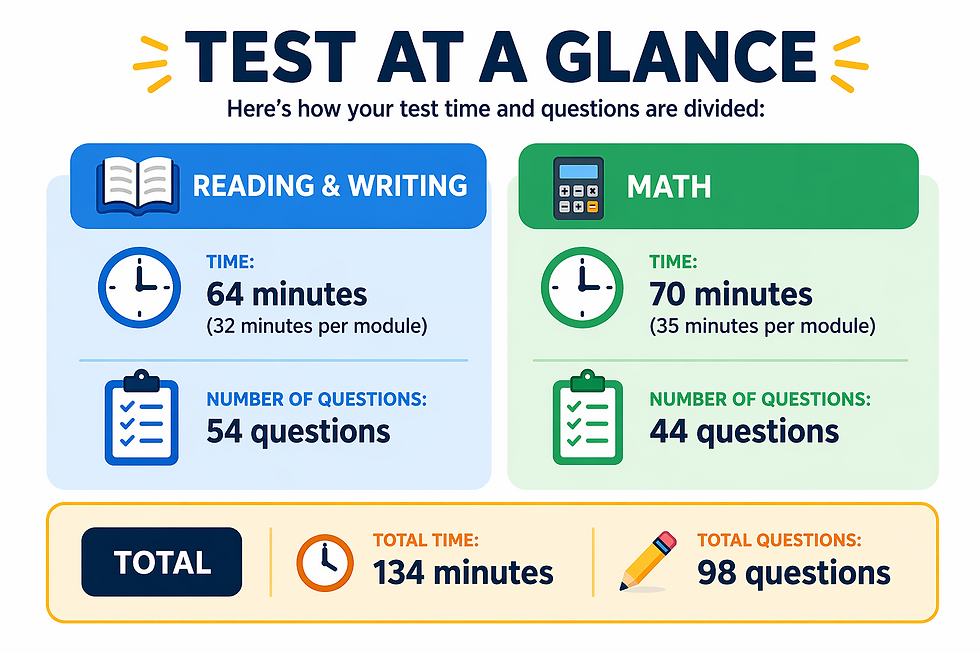
The SAT is organized into two main parts: Reading and Writing, and Math. You'll have 64 minutes for Reading and Writing and 70 minutes for Math, a total of 2 hours and 14 minutes.
Each section is split into two modules of equal duration. After finishing Reading and Writing, you’ll get a 10‑minute break before starting the Math portion.
Home
SAT OVERVIEW
How the SAT Is Structured
The first module in each section includes a mix of easier, moderate, and more challenging questions. Your performance on that first module determines the difficulty level of the second one. Doing well leads to a harder second module, while lower performance results in an easier one.
Most items on the test are multiple‑choice, but a few Math questions require you to type in your answer instead of choosing from given options.
The SAT combines timed sections, adaptive modules, and a mix of question formats to assess both your knowledge and problem-solving ability efficiently.
The Reading and Writing Section
The Reading and Writing section includes brief passages, or sometimes paired passages, each followed by a single multiple-choice question. Every question falls into one of four main skill areas:
Craft and Structure
Information and Ideas
Expression of Ideas
Standard English Conventions
To make time management easier, questions that assess similar skills are grouped together. Within each group, they generally progress from simpler to more challenging.
This section is split into two modules, and each module contains a mix of questions from all four content areas.


SAT Reading and Writing Breakdown
PASSAGE CHARACTERISTICS
Passages in this section are short, typically ranging from 25 to 150 words. They cover a variety of subjects, including:
These questions evaluate your ability to:
Information and Ideas
Text Analysis: Understand and analyze texts
Inference: Interpret and draw conclusions
Evidence Synthesis: Locate and combine information
Data Interpretation: Work with data from visuals like tables, bar charts, and line graphs
These assess your ability to:
Standard English Conventions
Grammar: Correct grammar and sentence structure
Usage: Apply proper usage rules
Punctuation: Use punctuation accurately
KEY TAKEAWAY
This section tests both your reading comprehension and your writing/editing skills, using short, focused passages and targeted questions across multiple subject areas.
These questions measure how well you can:
Expression of Ideas
Clarity Revision: Revise writing for clarity and effectiveness
Organization: Improve organization and flow
Rhetorical Purpose: Adjust text to meet specific purposes or audiences
These questions evaluate your ability to:
Information and Ideas
Text Analysis: Understand and analyze texts
Inference: Interpret and draw conclusions
Evidence Synthesis: Locate and combine information
Data Interpretation: Work with data from visuals like tables, bar charts, and line graphs
Craft and Structure
These focus on your ability to:
These questions measure how well you can:
Expression of Ideas
Clarity Revision: Revise writing for clarity and effectiveness
Organization: Improve organization and flow
Rhetorical Purpose: Adjust text to meet specific purposes or audiences
These assess your ability to:
Standard English Conventions
Grammar: Correct grammar and sentence structure
Usage: Apply proper usage rules
Punctuation: Use punctuation accurately
KEY TAKEAWAY
This section tests both your reading comprehension and your writing/editing skills, using short, focused passages and targeted questions across multiple subject areas.
📘 The Math Section
The SAT Math section covers four major areas. Each one tests different skills that are important for school, careers, and real-world problem-solving. The four major areas covered includes:
Algebra
Advanced Math
Problem-Solving and Data Analysis
Geometry and Trigonometry
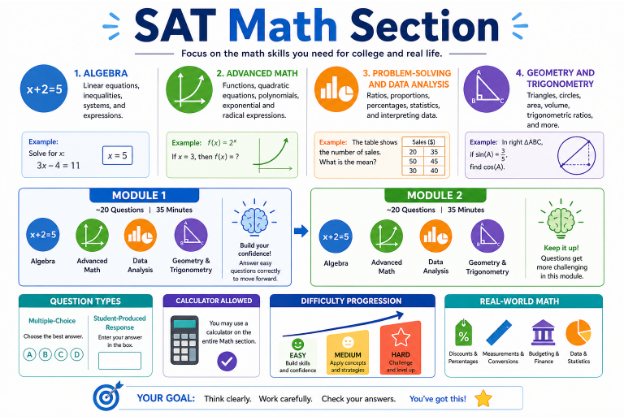
Questions are mostly multiple choice, with some student-produced responses where you enter your own answer.
The section is divided into two modules, and each module includes a mix of easy, medium, and more challenging questions. You can use a calculator throughout the entire section, which means the emphasis is on reasoning, modeling, and accuracy rather than memorizing complex calculations.
Overall, the SAT Math section measures how clearly and efficiently you can think through problems using fundamental math
🔢 Algebra
Algebra focuses on your ability to work with linear equations and inequalities and to solve problems efficiently using different methods.
Topics Includes:
-
Linear equations with one variable
-
Linear equations with two variables
-
Linear functions
-
Systems of two linear equations
-
Linear inequalities (one or two variables)
👉 You’ll need to solve, interpret, and sometimes create equations based on given situations.
📈 Advanced Math
Advanced Math emphasizes more complex equations and concepts that are useful for future studies in fields like science, engineering, and economics.
It tests your understanding of nonlinear relationships and your readiness for higher-level math.
Topics Includes:
-
Rewriting and simplifying equivalent expressions
-
Solving nonlinear equations in one variable
-
Solving systems of equations
-
Working with nonlinear functions (quadratic, exponential, etc.)
👉 Expect to work with expressions involving exponents, polynomials, and radicals.
📊 Problem-Solving and Data Analysis
This area measures how well you can apply math to real-world situations using data and quantitative reasoning.
Skills tested include:
-
Ratios, rates, and proportional relationships
-
Unit conversions and unit rates
-
Percent calculations
-
Interpreting one-variable data (like averages and spread)
-
Analyzing two-variable data (such as scatterplots and trends)
-
Basic probability and conditional probability
-
Drawing conclusions from sample data and understanding margin of error
-
Evaluating statistical studies and claims
👉 This section is all about making sense of data and using math in practical contexts.
📐 Geometry and Trigonometry
This section focuses on spatial reasoning and relationships between shapes, angles, and measurements.
Topics Includes:
-
Area and volume formulas
-
Lines, angles, and triangle properties
-
Right triangles and basic trigonometry
-
Circles and their properties
👉 You’ll apply formulas and geometric reasoning to solve problems.
✏️ Student-Produced Responses (SPR)
Not all math questions are multiple choice.
-
About 75% of the questions are multiple choice (with four answer options).
-
The remaining questions require you to enter your own answer, known as Student-Produced Responses (SPR).
Key features of SPR questions:
-
You must solve the problem and type in the answer yourself
-
There are no answer choices to guide you
-
Some questions may have more than one correct answer, but you only need to provide one
👉 These questions test your ability to solve problems independently without hints from answer options.
KEY TAKEAWAY
The SAT Math section evaluates a mix of Algebraic skills, Advanced equation solving, Data interpretation, Geometry and Trigonometry along with your ability to solve problems both with and without answer choices.
KEY TAKEAWAY
The SAT Math section evaluates a mix of Algebraic skills, Advanced equation solving, Data interpretation, Geometry and Trigonometry along with your ability to solve problems both with and without answer choices.
KEY TAKEAWAY
The SAT Math section evaluates a mix of Algebraic skills, Advanced equation solving, Data interpretation, Geometry and Trigonometry along with your ability to solve problems both with and without answer choices.